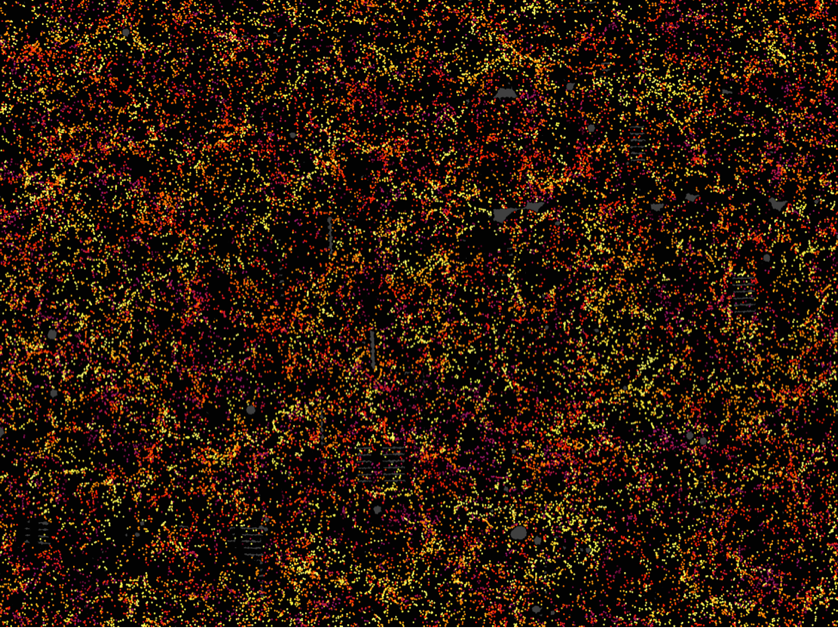
The Universe is full of galaxies and large-scale structure. As an illustration, Figure 1 shows a small patch of the Universe mapped out by the Sloan Digital Sky Survey (SDSS) and the Baryon Oscillation Spectroscopic Survey (BOSS). Each speck in the map corresponds to a galaxy. There are 49,000 specks in the image, just a tiny fraction of the more than 2 million galaxies mapped by these surveys so far.
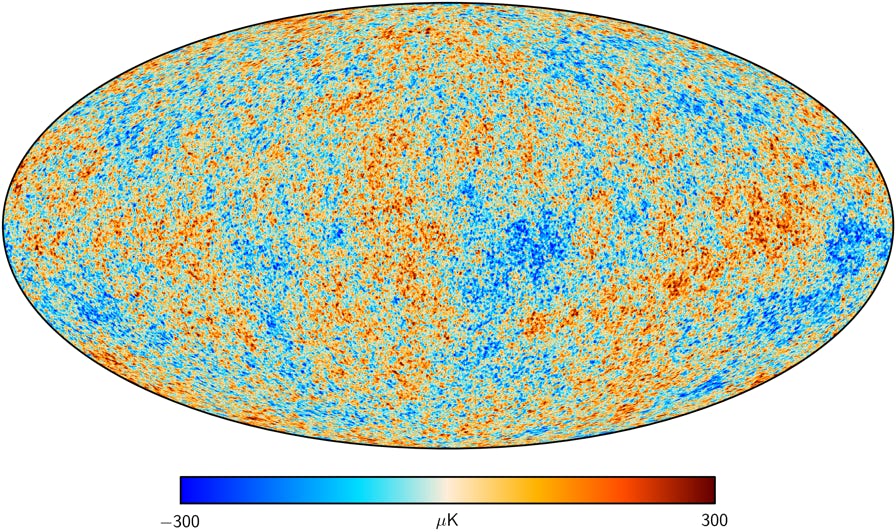
But the Universe was not always this structured. Using radio telescopes, astronomers can see all the way back to a time before there were galaxies. Figure 2 shows the cosmic microwave background, measured by the Planck satellite. You can think of this image as a snapshot of the Universe when it was just ~400,000 years old, a time when the Universe was much hotter and denser than it is today, and well before any galaxies existed. The splotches represent extremely tiny deviations from uniformity in the primeval fireball. These are the “seeds” for the structures, including galaxies, that exist in the Universe today.
Some time before the Universe was ~200 million years old, the first galaxies began to form out of the cooling matter. Broadly speaking, my research focuses on understanding this period of the first galaxies.
This period, termed “cosmic dawn,” also marks the first appearance of starlight and it had a profound effect on the Universe thereafter. The starlight ionized and heated most of the gas in the Universe, inducing a cosmological transition that we call reionization. Much of my research is devoted to understanding the physics of the reionization process.
My research group’s main tool is cosmological simulations run on supercomputers.